

The
logiCALM™
Framework
The Methodology Behind the Results
The Framework: How We Engineer Resilience
Our proprietary approach to Emotional Intelligence Engineering and Mindfulness.
High-stress environments create biological noise that leads to poor decisions and communication breakdowns. Gone unchecked, this noise leads to major internal system failures like physical and mental health challenges resulting in burnout, turnover, or even hospital visits.
Our workshops utilize the logiCALM™ Framework to clear that noise, allowing your team’s talent and skill to take center stage even under pressure.
If you are not a technical engineer or IT professional looking at this methodology, don’t worry, this applies to non-technical professionals as well. And yes, we explain everything in non-technical terms making it easy to understand and digest.
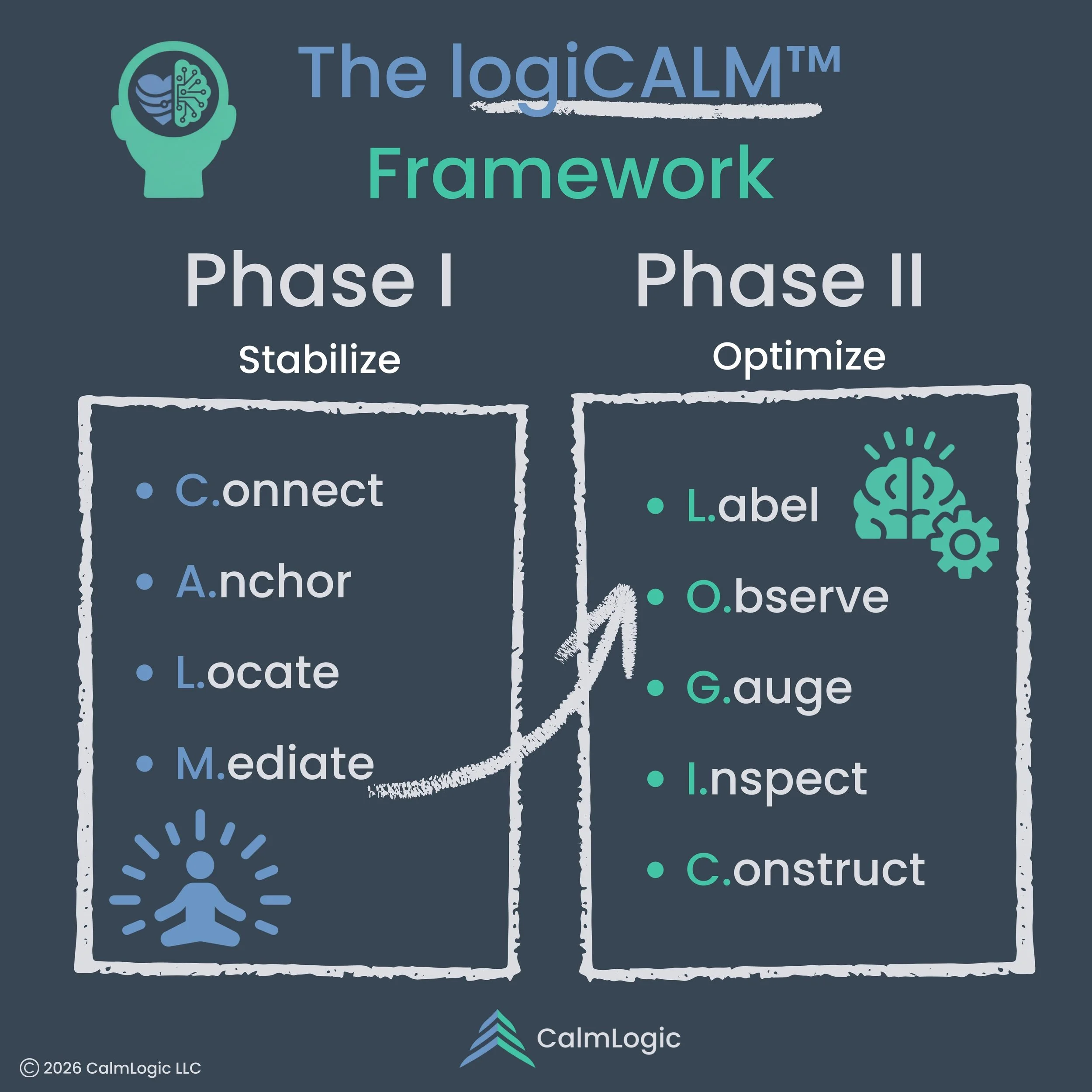

Phase 1: The C.A.L.M. Protocol (Stabilization)
Before you can think logically, you must stabilize the biology.
-
Establish a connection to the internal network to see physical signals (stress response) in action. Avoiding numbing or ignoring. Before you do anything you have to be aware.
-
Biometric override. Execute controlled breathwork to clear the noise queue and shift the nervous system into operational readiness. Get back into the present moment. Switch from the Sympathetic (fight or flight) nervous system to the Parasympathetic (rest and digest) nervous system.
-
Trace the physical path. Map exactly where tension is stored (high utilization) to identify which biological systems are being impacted. Note the physical sensations (chest tight, jaws clenching, etc.) This brings awareness back into the body.
-
Deploy a mediation layer. This is a buffer between the body and mind. Use a 30-second micro-meditation to create a buffer between physiological sensations and cognitive analysis. Acknowledge the emotions without pushing them away or flaming them.

Phase 3: The L.O.G.I.C. Framework (Optimization)
Once the body is calm, the mind can be precise.
-
Identify the specific emotion to ensure the network is routing the emotions correctly. Like distinguishing between Frustration and Fatigue, Anger and Anxiety, or Stress and Overwhelm. Incorrect labeling causes undesired outcomes.
-
Non-interfering monitoring. Watch the flow of thoughts like a packet sniffer, observing the sensations without getting caught in it yourself. Adopt a “Mindful” State. Watch from the observation deck.
-
Real-time telemetry. Measure the intensity of the emotion to determine if the network has stabilized enough for deep-level troubleshooting. Emotions are data, what is the data telling you?
Go/No-Go decision on next steps. Revert back to C.A.L.M Protocol if too intense, or escalate to SMEs.
-
Root Cause Analysis (RCA). Deep-dive into the data to find the “bug" (the core belief or trigger) that caused the signal to fire. Get curious. Ask why? Why was that response initiated? What value or need is being communicated?
-
Final Output. Build and execute a resolution plan: Create new boundaries, SOPs, logical communication, or tactical action plans.
How do you respond to the office/family/yourself?
Build the world you want to live in. High-EQ delivery of the data you just processed. What are you going to do differently?